Originally published in The Boston Review on August 6, 2025. Translated to Persian for Political and Economic Critique and Spanish for Nexos.
When Israel launched a surprise attack on Iran on June 13, its announced goal was to destroy an adversary’s nuclear program. But within days, mission creep set in. Israel’s prime minister, Benjamin Netanyahu, openly admitted the operation might lead to the overthrow of the Islamic Republic. By the final day of fighting, Donald Trump, who supported the attack from the beginning, joined Netanyahu in speaking of regime change.
The U.S.-Israeli line was hardly surprising. For Netanyahu, regime change is a constant objective, whether the target is Hamas in Gaza or Hezbollah in Lebanon. And while Trump occasionally demurs for the cameras, he has been eager for escalation in Iran, whether that means assassinating its leaders, banning its citizens from the United States, or ratcheting up sanctions and scuttling the 2015 nuclear deal on the basis of false claims of noncompliance. Indeed, regime change in Tehran has been on the U.S. agenda for generations.
More surprising were cheers for the attacks heard from corners of the Iranian diaspora. While Netanyahu and Trump bombed Iran, dozens of prominent Iranian Americans waved Israel’s flag and pled for harder strikes. Among those welcoming the attacks was sixty-four-year-old Reza Pahlavi, son of the king (shah, in Persian) whom Iranians overthrew in the revolution of 1979. “This is our Berlin Wall moment,” he declared.
Pahlavi has neither accomplishments nor grassroots popularity to draw on, but he does have a famous name and immense family wealth. In early 2023, he tried to build a coalition with opposition Iranians outside the country, but it promptly collapsed. Nonetheless, Pahlavi is fond of pretending that his “restoration” to the crown is a fait accompli. He spent the twelve-day war in June insisting that the Islamic Republic was on its last legs and that he would return to Tehran on the back of U.S. tanks and Israeli missiles, going so far as to boast of plans for his first hundred days in office.
There is more than a whiff here of the delusion promoted by Ahmad Chalabi, the Iraqi exile who hyped the 2003 U.S. invasion by insisting that Baghdad would welcome American soldiers (“They believe [U.S. troops] are liberators,” he claimed, improbably.) The reality is that democracy movements within Iran reject the former dictator’s son. “Death to the oppressor, whether he be a shah or a religious leader” went one of the slogans of the 2022 Woman, Life, Freedom protests. For these activists and so many others, Pahlavi is little more than a reminder of the despotism his father presided over with the aid of U.S. backers.
And yet, over the last few years, Pahlavi has been a constant figure on Persian-language TV and social media; a growing number of Iranians have seemingly embraced him, and internationally, his profile has never been stronger. How did he win such prominence?
These developments can look organic to many Westerners, but behind them lies a coordinated media manipulation campaign. The governments of Israel, Saudi Arabia, and the United States, alongside private actors, have spent millions building up Pahlavi and regime-change sentiment more broadly while promoting attacks on those who oppose him or U.S. and Israeli attacks on Iran. The propaganda effort takes two forms. First, Pahlavi’s backers have lavished funding on monarchist Persian-language TV outlets, where he appears regularly. Second, they have built a digital network of social media accounts to spread disinformation and target pro-democracy voices—those Iranians, at home and abroad, who oppose the regime but also reject kings and foreign-backed coups. Pahlavi’s supporters are primarily exiles, backers of the shah or their descendants, but with the help of royalist broadcasters, D.C. think tanks, and online trolls, he has gained ground among Iranians desperate for an alternative to the Islamic Republic.
The rise—or, more accurately, inflation—of Pahlavi is only the latest chapter in foreign regime-change agendas directed against Iran. Outside powers have repeatedly tried to impose reactionary leadership on the oil-rich country, for a variety of structural reasons. Iranian democracy is not in the interests of either Saudi Arabia—which fears nothing so much as democracy next door—or Israel, which prefers a pliant dictatorship to a popular government that may well be committed to a future for Palestine.
In many respects, then, Reza Pahlavi is a useful man—the ideal stooge for a decades-old strategy to erase Iranian independence. While Trump has vacillated, backing away from talk of regime change while simultaneously threatening Iran’s supreme leader, Pahlavi plays the role of the Iranian patriot standing against the regime and for “secular democracy.” His assiduously cultivated media profile is based on the lie that he enjoys organic support, yet his megaphone itself is real and the lobby behind him sophisticated. Actual Iranian democrats view Pahlavi as their enemy rather than their champion. But the political interests backing him up have invested hundreds of millions in giving him the illusion of public support, and he has been happy to go along. They want an Iranian face to justify bombing Iran, and Reza Pahlavi has shown he is more than willing to cheer the slaughter.
To understand this man who would be shah, we have to understand Iran’s modern history as an object of the imperial imagination.
Pahlavi was born in 1960, but his story begins in 1905, with a grassroots rebellion against a power that, for many, could no longer be tolerated: the Qajar Dynasty, an absolute monarchy that had ruled Iran for more than a century. The demand, shared by revolutionaries across Asia at the time, was constitutionalism. Amid a devastating civil war, Great Britain and Tsarist Russia intervened on the side of the Qajars. Yet the rebels succeeded in establishing a basic law, the Persian Constitution of 1906, that limited the monarchy’s power.
Soon after, a young army officer overthrew the Qajars in a coup and declared himself king—Reza Pahlavi’s grandfather and namesake. The new shah consolidated power by suppressing independent media and opposition parties, turning the nascent parliament—the constitutional constraint on royal authority—into a rubber stamp. His success owed much to British aid. From London’s point of view, Iran, squeezed between British colonies in Iraq and India, was well within the imperial sphere of influence. More immediately, Iran’s oil resources were crucial to supplying British military forces. The British had strong-armed their way into oil rights in the country already, but tensions were ever-present. A grateful Reza Shah would be a valuable ally of the colonial enterprise.
That dream died during World War II. In 1941 the United Kingdom and the Soviet Union invaded and occupied Iran, exiling the shah and putting his eldest son, Mohammad Reza Pahlavi, on the throne. Pahlavi II, a teenager at the time, was inexperienced and disoriented, and at first he failed to rule with the iron fist of his father. Independent political organizing flourished; leftist parties attracted thousands of followers, and secular nationalists promoted democratic rule. Throughout the late 1940s parliamentary elections grewsignificantly freer and fairer, and by 1951, voters managed to get Mohammad Mossadegh elected as prime minister. His popularity centered on promises to defend national self-determination and build a more equitable economic order, in part by nationalizing Iran’s oil resources. When thousands filled the streets to support Mossadegh’s vision, the shah fled, and jubilant crowds tore down his statues.
The United States offered aid on the condition that Mossadegh reestablish order, but the CIA was secretly disturbed by Mossadegh’s rise—U.S. policymakers didn’t want another country of the Global South asserting control over its own resources. They were not alone: Mossadegh’s policies engendered opposition from entrenched interests, including Iran’s monarchists, industrialists, and religious establishment. The CIA sought to amplify these views by paying mobs to rally, creating the illusion of popular support for the shah. At the same time, the agency supported a military faction planning to carry out a coup.
In 1953, led by a gangster named Shaban Jafari, who became infamous to Iranians as Shaban the Brainless (Shaban Bi-Mokh), the CIA-backed crowds filled the streets demanding the shah return. In the midst of the chaos, BBC Persian broadcast a message triggering officers to launch the coup. Mossadegh was arrested, independent political movements were repressed, and the shah returned, finally establishing full autocratic control. In the months that followed, BBC Persian called these events a “popular revolution.” The shah would not waste a second chance. His rule became increasingly corrupt and draconian, founded on torture, murder, incarceration, and intimidation at the hands of the SAVAK, Iran’s Israeli-trained secret police.
As a major force behind the forcible installation of a tyrant, the United States came to be seen by many Iranians as the foremost obstacle to their freedom. The mass protests of the late 1970s were directed at both the shah and his U.S. enablers. Leftists, nationalists, and Islamists had starkly different visions for Iran’s future, and many would eventually find themselves on the wrong end of bloody repression by the Khomeinist faction that triumphed in early 1979. But at the time, all agreed that the shah had to go and that the Americans had to be prevented from reinstalling him. It was this sentiment that underlay the occupation of the U.S. Embassy in Tehran in late 1979. Americans remember a brazen act of hostage-taking, but revolutionary Iranians saw the occupation as an effort to prevent yet another coup, out of fear that the United States was poised to return the shah to power. At any rate, Mohammad Reza Pahlavi was too ill for another stint on the throne. He died in July 1980 in Cairo, following unsuccessful treatment in the United States.
U.S. attention soon turned to his teenage son, Reza Pahlavi. Iranians at home were introduced to him in 1986 when state TV was interrupted with a video of Pahlavi proclaiming “I will return,” broadcast from a transmitter supplied by the CIA. But he proved a reluctant coup-maker. The following year, he was approached with a Bay of Pigs–style plan bearing former president Richard Nixon’s blessing: Pahlavi and his supporters would be dropped on Kish Island and then, under U.S. military cover, make their way to the mainland. There, joined by the legions of Iranians welcoming their king, they would march north to capture Tehran. When Pahlavi was informed, he balked. The only question he asked was, “How are we going to escape if things go wrong?” Perhaps Pahlavi sensed he would not be welcomed after all.
Instead, he contented himself raising cash from exiles. In just two months of fundraising in 1989, he collected $1 million. “Propaganda is not cheap,” he explained, predicting it would be “two to three years maximum” before he returned to Iran. That never happened, but he kept trying, again and again. In 2003, while U.S. forces were fighting in Iraq, Pahlavi met with Netanyahu to brainstorm another U.S. invasion, this time of his homeland.
Meanwhile, Iranian politics were roiling. Throughout the 1990s, squatters and workers movements challenged the Islamic Republic’s neoliberalizing policies. In the 2000s, feminists and civil society organizations developedmass movements outside the sphere of political parties, while reformists worked to expand democratic institutions within Iran’s tightly controlled official politics. The 2009 Green Movement saw months of continuous protests, reflecting the growing domestic challenge to autocratic rule. Fed up with the status quo, pro-democracy Iranians came out in force for the 2009 elections and would have carried the day had the government not manipulated the results. Pahlavi expressed his support for the democracy movement, even as he continued to insist he was Iran’s legal king.
His comments were widely mocked. Iranians had fought for democracy for a century; they fought the shah and now they were fighting the rahbar, the supreme leader. Pahlavi had nothing to do with the democratic future they were protesting for. He was easy to ignore—until he wasn’t.
The Persian-speaking diaspora has long sought to penetrate Iran’s closed media environment through satellite TV channels. The first of these, broadcasting from Los Angeles, London, Toronto, and Dubai, emerged in the 1990s, as Iranian emigres rebuilt their culture industry abroad. Programming interspersed Persian pop videos and political ranting, but production quality was low due to lack of funding. Persian-language channels with higher production values, like BBC Persian and Voice of America, were backed by foreign governments. Although they occasionally interviewed Reza Pahlavi, they never presented him as Iran’s future leader.
But then, in the 2010s, two new private channels emerged. Polished, sophisticated, and broadcasting a wide array of content, Iran International and Manoto reshaped the Persian-language media environment. Around 70 percent of Iranians inside Iran have satellite TV, and many get their news from satellite channels; these two are among the most popular. They are also highly secretive about their funding: both refuse to identify any paymasters. Nonetheless, a 2018 Guardian investigation found that Iran International received a quarter billion dollars from Saudi Arabia, which advocates for U.S. war and sanctions against Iran. The channel also cheerfully publicizes its journalists’ meetings with Israeli intelligence.
Both channels push a strongly nostalgic editorial line that favors a return to monarchy. The flag of pre-1979 Iran is flown during broadcasts, and Reza Pahlavi appears as a regular guest. Manoto, in particular, produces wistful documentaries about the shah’s rule, reprising the shah’s propaganda of old and pressing, as he did, the theme of Pahlavi-ruled Iran as forward-looking modern state. The network somehow draws on the pre-1979 state TV archive; how Manoto acquired the reels is a mystery.
This nostalgic programming notably shies away from the extreme inequality and near-total crushing of free speech under the shah’s rule, focusing instead on rehabilitating the Pahlavis’ image. Manoto has gone so far as to justify atrocities, releasing a softball interviewwith former SAVAK deputy Parviz Sabeti, whose victims describe him as the “architect of the institutionalization of torture in Iran.” The irony is that many of the worst traits of the Islamic Republic—those most cited by opponents as justifying regime change—find their roots in the Pahlavi era so rosily portrayed on Iran International and Manoto’s programs. Evin Prison, the notorious confines of Iran’s political prisoners, was known in the Pahlavi era as “Evin University” because it jailed so many intellectuals and journalists. Yet viewers are invited to see the monarchy as the superior, indeed only, alternative to the Islamic Republic.
Never asked to defend his vision or own up to the monarchy’s crimes, Reza Pahlavi fills the airwaves with calls for regime change and predictions of the government’s imminent demise while he waits in the wings to return as king. And when Iranians themselves take to the street to denounce their leaders, Pahlavi is there to “translate” their supposed wishes: when they call for revolution and economic justice, he says, what they really want is foreign-backed regime change and a return to the ancien régime he will restore. Despite being hounded by security forces, pro-democracy activists in Iran take time to refute Pahlavi’s claims, again and again, in statements smuggled out of prisons and communiques penned by labor unions.
In effect, Pahlavi and the networks have joined forces to create a monarchist feedback loop that tars and suppresses genuine democracy movements. In the late 2010s, when worker-led protests rocked Iran, slogans that first appeared on Manoto—bashing reformers or praising the Pahlavis—were repeated by some on the streets; TV channels then replayed cherrypicked videos, giving a misleading impression of the extent of monarchist support while excluding other chants. Today, Iranians glued to Manoto or Iran International could be forgiven for assuming the downfall is well underway—rhetoric that discourages the sort of activism that might reshape and democratize Iranian society from within.
But if Iran isn’t going to change through activism on the ground, how is it supposed to change? The clear implication is that external forces are to be welcomed. When Israel and the United States kill Iranians or strangle its economy, Iran International and Manoto describe them as targeting only “the regime.” Civilian casualties are downplayed or ignored, projecting the fiction that an outside power could attack while sparing the public and inviting the very people who will be under the bombs to rally around the man cheering for war.
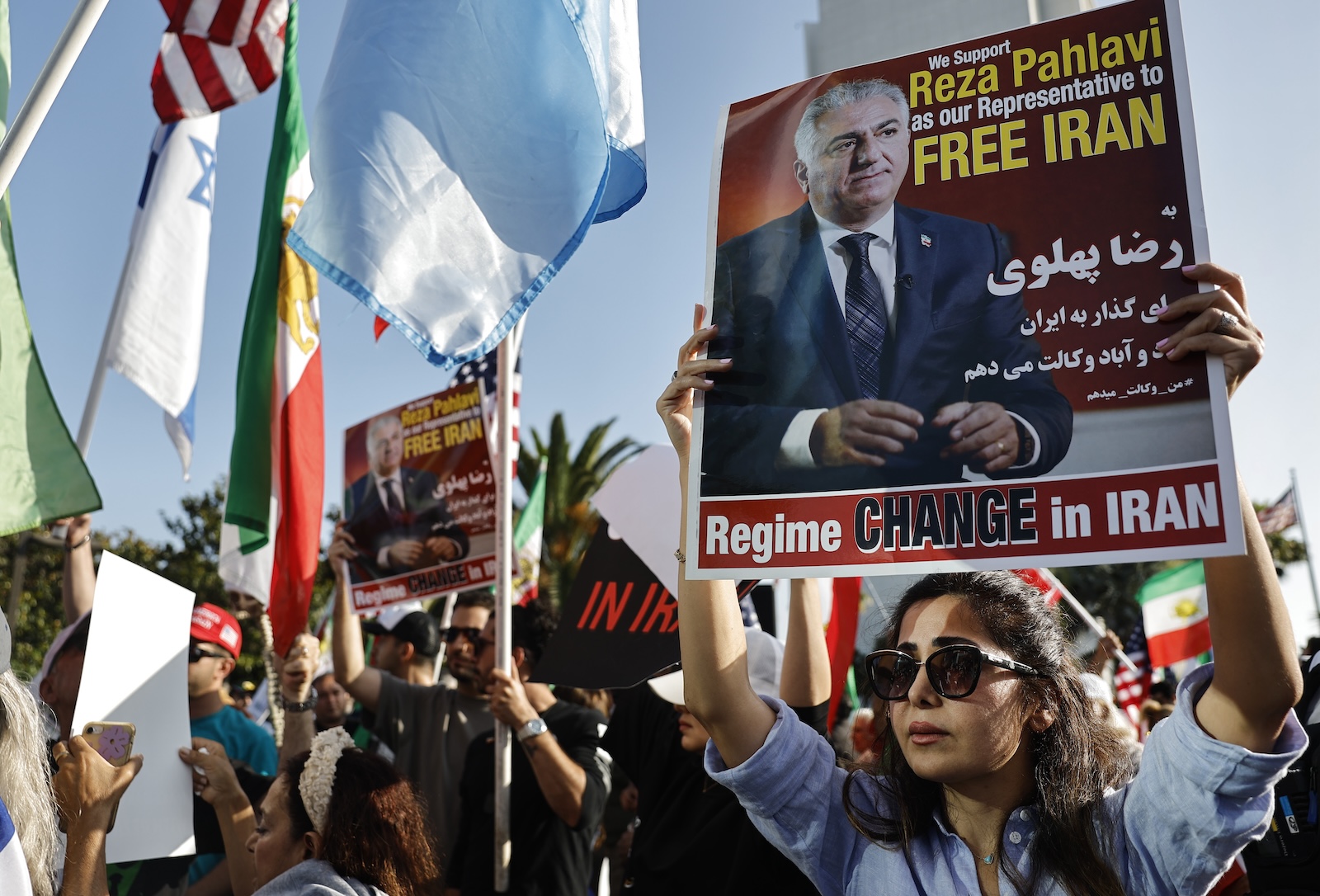
And then there is the online campaign. Iranian Americans are a durably progressive community. A 2008 survey found they were more than four times more likely to be registered Democrats than Republicans, while two-thirds thought diplomacy with Iran was in the best interest of the United States. And more than a decade and a half later, these figures haven’t changed much. Iranian Americans were active in opposing Trump’s Muslim ban, which targeted their families, and have broadly opposed U.S. sanctions on Iran. A 2025 survey taken before the June war found that most Iranian Americans oppose a U.S. attack on Iran.
Yet, on social media platforms like X/Twitter, the diaspora Iranian voices with the most followers are Trump-supporting, Israel-loving advocates of war and sanctions, while Iranian Americans who oppose these policies are besieged by angry comments in English and Persian. The disconnect is jarring, but then again familiar for anyone who has spent enough time online: it has the telltale feeling of a bot or troll attack. And in fact, evidence has come to light in recent years revealing an extensive campaign of social media manipulation, powered by Israel, Saudi Arabia, and the United States, that has artificially amplified a small contingent of right-wing influencers boosting regime change and bolstering Reza Pahlavi.
Manipulation of Iranian social media first became clear to me in November 2019. I was living in Tehran when protests broke out against a government plan to remove a gasoline subsidy. Hoping to quell the outrage and prevent organizing, the government cut off internet access nationwide. During that week, the state killed hundreds of people. Yet while the internet was offline, Iranian social media exploded with posts promoting regime change and Reza Pahlavi as “the voice of Iranians.” Thousands of tweets referenced protesters supposedly yelling, “Reza Shah Rouhet Shad” (“God Bless you Reza Shah,” referring to Pahlavi’s grandfather). Those of us in Iran were stupefied when the internet came back on and we saw what was happening online. Wherever these posts were coming from, it certainly wasn’t from inside the country.
All signs suggest that an influence operation was afoot—one episode in a broader, shadowy phenomenon that has slowly been brought to light by intrepid reporting and chronicled in studies like Marc Owen Jones’s 2022 book Digital Authoritarianism in the Middle East: Deception, Disinformation, and Social Media. Following the Arab Spring, bot armies developed to combat pro-democracy movements that were linked to Saudi disinformation networks. And after Trump came to power and ripped up the 2015 nuclear deal, fake accounts began to crop up, commenting en masse in support of Reza Pahlavi and against people and organizations supporting diplomacy between the United States and Iran. These accounts focused on promoting hashtags like “Trump Will Destroy Iran,” whipping up anger against those who dared to disagree. Others, like #IRGCTerrorist, demanded that the United States add Iran’s Revolutionary Guard Corps (IRGC), the politically influential military unit, to its list of foreign terrorist organizations. (Trump did so in 2019, and the designation has been maintained since then.)
Geoff Golberg is one of the online detectives who has helped unravel the scheme. The founder of Social Forensics, a social media analytics firm, Golberg reports that his interest was piqued in early 2019 by an expert on disinformation campaigns, Ben Nimmo, who was then a founding member of the Atlantic Council’s Digital Forensics Research Lab, later became Global Lead for Threat Intelligence at Meta, and now serves in a similar role at OpenAI. Nimmo had tweeted about suspicious Twitter traffic promoting a hashtag for the Warsaw Conference, a Trump-led summit aimed at building a global anti-Iran coalition. When Golberg started investigating, he discovered the hashtag had indeed been artificially amplified by fake accounts.
To follow up, Golberg began tracking accounts that had thousands of followers but no discernible physical existence, many associated with pro-Pahlavi groups. When Golberg wrote and tweeted about his findings, he was derided as a pawn for Iran’s regime, and he and his family were doxed, their addresses and phone numbers exposed. He discovered that many of the accounts appeared to be linked to the Iran Disinformation Project, a group funded by the U.S. State Department that was trolling human rights activists, journalists, and public figures opposed to war on Iran. Its targets included Jason Rezaian, a Washington Post reporter previously imprisoned in Iran, and Human Rights Watch researcher Tara Sepehri Far. As Jones puts it, “although . . . online abuse is unfortunately prevalent in almost every domain of politics, what sets the Iranian case apart is that the debate space was deliberately turned into a toxic bullying arena by the U.S. government”—an environment where “many analysts and academics writing about Iran are targeted for simply not being militaristic in their stance and demanding regime change.”
In May 2019, following reports about its attacks, the State Department terminated the Iran Disinformation Project’s contract. But through a Freedom of Information Act lawsuit, The Intercept later learned that funding was still flowing to the organization that implemented it, the E-Collaborative for Civic Education, which received nearly $10 million from the U.S. government during the 2010s to operate a number of projects related to Iran. Meanwhile, Golberg stayed on the case. In the wake of the U.S. assassination of IRGC general Qasem Soleimani in early 2020, he surveyed the hashtag #IraniansDetestSoleimani, identifying a large network of fake accounts and a handful of real figures connected to them, both linked to the Iran Disinformation Project. And the inauthentic accounts tweeted in far greater numbers than did organic accounts, achieving an outsized impact. Golberg described the campaign as “sockpuppets retweeting sockpuppets.” The rhetoric focused on characterizing antiwar positions as pro-regime.
Some of the dirty work of the Iran Disinformation Project was handled by the Foundation for the Defense of Democracies (FDD), a neoconservative think tank headed by Iraq War hawk and former Republican National Committee communications director Clifford May and backed over the years by the likesof the late billionaire Trump megadonors Bernard Marcus and Sheldon Adelson—the former a major donor to groups in Israel, the latter a major supporter of Netanyahu who once suggested nuking Iran. FDD Senior Advisor Saeed Ghasseminejad—who has more than 100,000 followers on X, where he identifies himself as a “classical liberal” and “nonpartisan”—was a contractor on the disinformation project, Responsible Statecraft reports; his was among the first real Twitter accounts to attempt to discredit Golberg. Today, FDD’s stated purpose is “strengthening U.S. national security and reducing or eliminating threats posed by adversaries and enemies of the United States.” But as The Nation reported in 2014, FDD began as Emet: An Educational Initiative, a group founded in 2001 that aimed, according to FDD’s application for tax-exempt status, to “enhance Israel’s image in North America.” The two goals have been blurred all along, and the waves of 2020 tweets promoting war on Iran advanced both at once. Or rather, they did so if you assume that propaganda efforts to clear a path for regime change in Iran “strengthen U.S. national security,” as the U.S. government apparently does.
These efforts seem to be just the tip of the iceberg of a wider attempt to destabilize Iran through social media manipulation. In 2017, Saudi royal Muhammad bin Salman met with the Israeli firm Psy-Group to discuss a plan that involved “creating fake social media accounts in Farsi to foment unrest in Iran” and “financing Iranian opposition groups.” A 2019 New Yorkerinvestigation called Psy-Group “part of a new wave of private intelligence firms that recruited from the ranks of Israel’s secret services” to “shape reality” through the “use of elaborate false identities to manipulate its targets.” Its founder, Royi Burstien, previously worked in Israeli intelligence; he boasted of “planting the seeds of ideas in people’s heads.” Psy-Group employees also met with the FDD. The firm closed in 2018 after coming under investigation by Robert Mueller, but the political interests it served live on.
Part of the difficulty in tracing and exposing cyber-warfare is that perpetrators generally deny they are waging it and are always eager to conceal it. But the fact that the Saudi government and Psy-Group took part in direct discussions, which both groups publicly deny took place, strongly suggests that the bot armies that have flooded Iran’s social media—powered by accounts showcasing crowns, lions, and Israeli flags and lavishing praise on Pahlavi—might be operating at the behest of the human ones.
More came in October 2022, as bots amplified the right-wing figures piggybacking on the Woman, Life, Freedom movement to slam antiwar voices as “regime apologists.” Spurred by the death of alleged hijab refusenik Mahsa Amini while she was in police custody, the movement demanded an end to gender and ethnic discrimination and to political repression. Bots and trolls followed, claiming to back the movement by campaigning against the Iranian government’s international “lobby,” comprising anyone outspokenly opposing a war for regime change. As Jones told Vox, the Mahsa Amini hashtag received more than 330 million tweets in just one month, while #BlackLivesMatter was tweeted some 83 million times over eight years. Numerous real accounts argued that opposing war and sanctions was tantamount to service as a regime agent, and antiwar activists were tarred as Iranian spies. These messages were then amplified by hundreds of thousands of fake accounts. An online activist who led attacks on Iranian-American journalists he viewed as insufficiently critical of the regime doubled his follower count in a month, almost entirely with bot accounts. Targets went silent amid the deluge of abuse.
As Golberg documents, Israel played a central role in manipulating the bot armies. (In fact, the Israeli government had been developing similar capacitiesfor years, even admitting in 2023 to deploying what the Associated Press characterized as “keyboard warriors” to spread propaganda online following its 2021 war on Gaza.) Buttressed by apparent Israeli cyber-brigades, tweets tarred the writer and activist Trita Parsi, co-founder of the Quincy Institute for Responsible Statecraft, as a puppet of the mullahs—unlikely, given his Zoroastrian faith—and the exiled journalists Farnaz Fassihi and Negar Mortazavi as regime agents. Anonymous harassers threatened to bomb the University of Chicago’s Institute of Politics, which had invited Mortazavi to speak, while bots spammed the institute’s social media with comments attacking her. (Those posts were removed, but similar bot comments are still visible on unrelated posts.) Even human rights activist and future Nobel Peace Prize winner Narges Mohammadi, who was being held as a political prisoner in Evin at the time, came in for abuse. Reza Pahlavi’s wife, Yasmine, fueled the attacks, alleging that Mohammadi was able to communicate with the world outside prison thanks to unsavory regime connections. In reality, she, like most prisoners in Iran, was allowed phone calls, and also regularly smuggled out notes.
The wave of online hate crested over the largest grassroots Iranian American civil society organization, the National Iranian American Council (NIAC). NIAC developed a base by opposing war and sanctions and championing Iranian American civil rights; it was also at one time a diplomatic powerhouse, encouraging the U.S.-Iranian negotiations that led to the 2015 nuclear deal. In late 2022, however, NIAC was repeatedly accused of secretly lobbying for the Iranian government. The supposed evidence revolved around a 2012 defamation case brought by Parsi, a founder of NIAC, against an activist for falsely accusing the organization of lobbying for Tehran. A U.S. federal judge ruled against Parsi, concluding there was insufficient evidence to meet the high legal standard of “actual malice” in the activist’s allegations but clearly stating that the ruling was not to be interpreted as a finding that the activist’s claims were true.
The outcome was nevertheless dredged up in 2022 as grist for a new propaganda narrative: NIAC had tried, and failed, to prove that it wasn’t a lobbyist for the Iranian government. The attacks on NIAC began with a video tweeted by Israeli American marketing consultant Emily Schrader, CEO of a company called Social Lite Creative, who boasts of working alongside the Israel Defense Forces to “spearhead . . . efforts on social media” regarding Israel’s 2014 war on Gaza. (Schrader’s husband, Yoseph Haddad, is a well-known pro-Israel influencer who served in the IDF.) Schrader shared the footage of herself, complete with Persian subtitles, in early October, a few weeks after the Woman, Life, Freedom protests broke out. For years, NIAC had expressed support for grassroots movements and protests in Iran and criticized the Islamic Republic’s human rights record; its website is full of condemnations of Iranian state repression. But in the video, Schrader falsely accuses NIAC of turning a blind eye to human rights and falsely declares it “an active body of the Iranian regime.” The accusations were rapidly amplified by a massive network of bots across Persian-language social media, and soon enough Iran International produced a documentaryrepeating the false claims.
NIAC contracted Social Forensics to carry out an analysis, which showed that, of the roughly 200,000 Twitter accounts involved in the online crusade, half were only a year or two old, and two-thirds had fewer than 300 followers. Relatively new accounts with few followers and fewer tweets were suddenly posting hundreds of times a day about NIAC’s supposed lobbying for Iranian dictator-mullahs and spewing tweet after harassing tweet at Iranian Americans who opposed war and sanctions. And while the low number of followers limited the reach of these posts, the accounts still played a role in “gaming” Twitter’s trending algorithm, Golberg noted. For its part, Iran International’s account gained legions of fake followers, as did Israeli voices broadcasting pro-Israel and pro-Pahlavi messages in Persian. Digging further, Golberg noticed some disturbing connections. Official Israeli government accounts—including those of Hananya Naftali, Netanyahu’s digital aid, as well as Israel Persian, the Israeli Foreign Ministry’s official-Persian language account—were following inauthentic, unverified Persian-language accounts with hundreds of thousands of followers that spewed out hundreds, at times thousands, of tweets per day promoting Reza Pahlavi and Israel.
Bot armies and social media manipulation have an impact. Yes, there exist real people, including Iranians both within Iran and abroad, who support U.S. and Israeli action against the regime. But real people are also susceptible to what they encounter online. When certain views suddenly comprise 90 percent of your social media feed rather than 10 percent, they can come to seem much more ordinary or plausible than they are. When you are harassed by trolls, you may choose not to speak up. Journalists, too, use social media to get a sense of public discourse; manipulating the narrative there can thus directly influence reporting. A case in point: in fifteen years, foreign-sponsored regime change has gone from being a fringe idea to an apparently genuine popular demand from Iranians. Or at least, that’s what it looks like online.
In April 2023 Reza Pahlavi visited Israel, where he was received by Netanyahu in a meeting organized by the FDD. The exchange reflected a convergence of mutual interests. In Pahlavi, Netanyahu has an Iranian voice who can give cover to his ambitions of overthrowing Iran’s government. Conversely, in Netanyahu, Pahlavi has a like-minded and well-armed benefactor. Israel has the firepower to take down the Iranian government all on its own, and the extensive network of pro-Israel lobbies and bot armies have helped to create for Pahlavi what he’s always craved but never had: the appearance of popular support.
Yet hardly anything could be more damaging to Iran’s pro-democracy movements than the insistence that opposition to the Islamic Republic requires supporting an unpopular, deposed monarch with ties to Israel and U.S. neoconservatives. The Islamic Republic has long sought to tar opponents with the allegation that they are stooges for Israel and the United States. By cozying up to Netanyahu while positioning himself as the voice of the opposition, Pahlavi is as good as proving them right. When Yasmine Pahlavi lauds Israeli soldiers for supposedly embodying the ideals of Woman, Life, Freedom, Iran’s freedom struggle takes a giant backward step.
Just like the Tehran mobs on the CIA payroll in 1953, propaganda efforts directed by State Department lackies and pro-Israel influencers create the illusion of popular support for installation of a monarch by foreign powers. With Iran International, Manoto, FDD, and keyboard warriors playing the role of Shaban the Brainless, the Iranian public is fed the narrative that only Reza Pahlavi can save them—and that war is the only way for Iranians to live in peace and freedom.
After years of braying for regime change, Pahlavi and his backers finally saw an opening in June’s war. It didn’t bring down the regime as they hoped, but it did kill a thousand Iranians and further undermined the grassroots movements some of them had spent years building. The missiles gave Iran’s government another excuse to crack down, while leaving authorities even more paranoid about rooting out the enemies within. Rather than recognize that foreign intervention has made life harder for Iranians and prevented them from organizing, Pahlavi cheers the bombs and calls for solutions that can only hurt the cause he claims to fight for. As a sociologist in Tehran told me in July, “How can we protest when we’re running from bombs?”
Actual “freedom-loving Iranians” are the ones being discredited, or worse. The activists putting their lives on the line for democratic change, as well as those standing in solidarity with them, are the ones suffering—not hardliners in the Iranian regime, who are only too happy to watch the domestic democratic opposition and diaspora pro-diplomacy organizations like NIAC crumble under right-wing assault. The true winners are not the Iranian people but the imperial architects inside Israel and the United States.