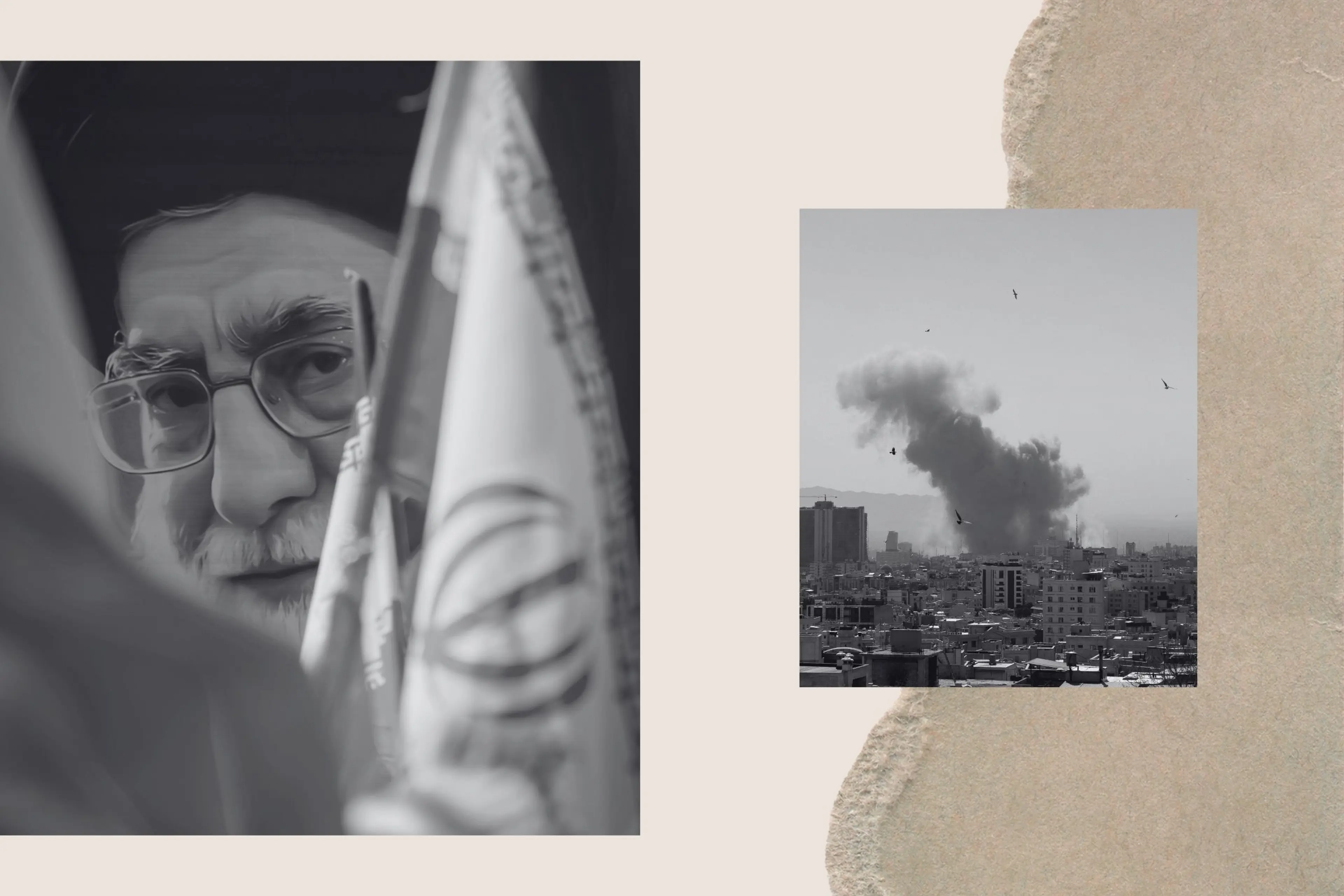
Ayatollah Ali Khamenei’s portrait is everywhere in Iran. His head is usually turned slightly away, while his pinching eyes stare straight at you. His smile, coyly upturned at the corners, gives the impression of a patriarch who would resort to violence at the first sign of disobedience. And although I couldn’t see him from behind the blindfold, I knew he was there, watching us in the underground detention center in Tehran where I was being held in the summer of 2010. I knelt on the cold, hard floor, hands tied behind my back, listening to interrogators beat and taser my fellow detainees who, only moments before, had been chanting together for freedom in the streets.
I was detained during the last gasps of the Green Movement protests in 2009. Millions of Iranians had rallied around the presidential campaign of Mir Hossein Mousavi—a former prime minister turned government critic—who electrified crowds with his pledge to transform Iran into a genuine democracy and defend social equality. Khamenei saw in Mousavi an existential threat. He rigged the vote in favor of his preferred candidate, the incumbent Mahmoud Ahmadinejad. When protestors took to the streets demanding a recount, the Supreme Leader showed us what was behind that smile: he unleashed a crackdown that killed dozens, swept thousands into prisons and detention centers, and enraged millions more. Mousavi was placed under house arrest, where he remains to this day.
Looking back, the suppression of the Green Movement was a turning point. Here was Khamenei making clear that he would stop at nothing to subvert the democratic ambitions of his people, and Iranians drew the logical conclusion: the Islamic Republic would not be reformed from within, not on his watch. The plaintive chant of “Where is My Vote?” escalated to something far more defiant: “Death to the Dictator!”
On Feb. 28, Khamenei was killed during the first wave of military strikes by the United States and Israel on Iran. Word of his death arrived quietly, with the faint buzz of a phone notification. At first, I struggled to believe it. Soon, I was overwhelmed by fear for the safety of my loved ones taking cover from the bombs pulverizing Iran and trepidation about my country’s uncertain future. I wanted Khamenei to face justice for what he did to Iran. Yet I did not want him to be killed in this manner, in a war waged without even the pretense of legal backing by Donald Trump and Benjamin Netanyahu. I wanted Khamenei gone, not assassinated, but held to account.
I know my view is not universal. Many Iranians celebrated his death. I received hopeful messages from relatives about the dawn of a new era of light. Khamenei left Iranians hopeless and afraid, with few avenues for seeking political change that didn’t end in exile or death. Some became so desperate that they prayed for foreign bombs to save them. I recognize the joy they felt. But as the U.S. and Israel continue to bomb Iran, their cheers have fallen silent.
A nation transformed
Ayatollah Khamenei assumed the mantle of Supreme Leader of Iran in 1989. I was born barely a year after. My father had fled Iran after the Revolution, blacklisted by a new government that regarded anyone associated with the Shah as a threat—even an architect working with a government ministry. Khamenei’s ascension came a mere 10 months after the end of an eight-year war with Iraq, one that had ravaged Iran’s economy, demolished its infrastructure, depleted its foreign reserves and left its people exhausted.
Khamenei focused on reconstruction and oversaw a period of steady economic growth. He continued expanding education and social welfare, dramatically improving basic quality-of-life indicators—particularly in rural areas that had long been neglected. He introduced a progressive system of family planning and a community-basedhealthcare system that extended life expectancy and became a global model. He also permitted capitalist reforms to be implemented, ushering in a consumer culture and a growing divide between rich and poor. And he facilitated the Revolutionary Guards’ evolution from a purely military force into an institution with its hands deep in virtually every sector of the economy.
These were the years when I first got to know Iran intimately, as my father started taking us back to visit. My earliest memories are familial: the glimmer in my grandmother’s eyes as we arrived at Mehrabad airport in Tehran; long summer afternoons spent playing with my cousins in her jasmine scented garden; a road trip in a sky blue van to the shores of the Caspian Sea. My father would take us around Tehran, his hometown, showing us the mirrorwork of Golestan palace and his favorite shop for mortadella sandwiches. He would often lose his bearings in a city where street names had changed along with its politics.
One of those days, my father showed me his old office, a white marble-clad building on a tree-lined avenue in downtown Tehran. It would have been avant-garde in the 1970s; now it looked like a relic in a city swallowed by new construction. I stood on the sidewalk staring up at the third-floor balcony, imagining my father as a hopeful, ambitious young architect, designing skyscrapers. I wondered what his life would have been had he never been forced to leave.
Khamenei’s stern eyes stared at us everywhere: from the airport to the kebab restaurants and pomegranate juice stands, from the beach hotels to the lakeside boat rental shops. But the Iran he watched from his framed portraits on those walls was also changing in unexpected ways. The material wounds of the war were healing. From that liminal moment emerged Mohammad Khatami, a former culture minister steeped in philosophy and theology, and a committed reformist. In the 1997 presidential elections, Khatami defeated the Supreme Leader’s preferred candidate, with support from an electorate longing for greater political and social freedom and a dialogue with the West.
The Khatami years witnessed the blooming of hundreds of independent newspapers and magazines, and thousands of civil society organizations, as Iranians took advantage of an opening after decades of suppressed aspirations. In deference to the new atmosphere, authorities quietly relaxed the strict Islamic codes that had governed, and limited, social freedoms since the revolution of 1979.
Khamenei presided over the opening but also interfered with it, reasserting the supremacy of clerical rule over participatory democracy every step of the way. In July 1999, after a reformist newspaper, Salam, was shuttered by the authorities, students at the University of Tehranprotested. Basij paramilitaries, loyal to Khamenei, stormed their dorms and attacked them. In August 2000, he forced the reformist Parliament to abandon the passage of a bill expanding free speech and removing restrictions on the press. He enraged many Iranians by encouraging his supporters to intimidate dissidents while maintaining plausible deniability. He would pay lip service to democratic legitimacy, but mock the nation with his smile and turn a blind eye to murders committed in his defense.
Yet in his campaign of suppression, he dismissed a fundamental truth: Iranians had a long tradition of struggling for democracy and social justice, extending from the 1905-11 Constitutional Revolution to the 1979 uprising against the Shah. They drew on this legacy as they continued to find new ways to press for a more democratic country. Feminist activists gathered signatures to change sexist laws, students heldpolitical debates, unions went on strike to stop economic austerity measures.
I watched in awe from Los Angeles, and learned more during my summer visits. Iranians were constantly navigating red lines while demanding accountability from those in power. Lawyers risked their lives to challenge cases of police brutality. Young women defiantly flouted mandatory hijab laws. Journalists exposed the corruption and crimes of government officials. They cycled in and out of prison, but they never stopped fighting.
Understanding Iran
After the Sept. 11, 2001 attacks, American democracy revealed its own fragilities. I followed the invasion and occupation of Afghanistan and Iraq and I watched American officials lie to the American people to justify wars of regime change in the name of liberation. I saw images of American soldiers raiding homes in Baghdad and Kabul and families crying as their sons were taken into arbitrary detention. While many other Americans saw those Iraqis and Afghans as faceless Muslims in an enemy country, those images transported to me my grandmother’s jasmine scented garden, those faces reminded me of my cousins. As the death and disorder brought about by American regime change warsmultiplied over the years, I became increasingly certain of a truth I had just started to grasp: freedom couldn’t be imposed from above; it would only come from popular struggles in a society. I joined American protests to stop the wars.
I dreamed of ways to support the struggles I had witnessed in Iran. But after the Green Movement was crushed, I forced myself toward a more cautious approach. I had to learn how Iran worked before I presumed to help change it. I enrolled as a doctoral student in anthropology at the University of Chicago, and when the time came for fieldwork, I returned to Iran for research on power and resistance. I rented an apartment around the corner from my father’s old office in Tehran. I spent my days interviewing activists and government officials, journalists and members of the paramilitary Basij, trying to understand the Iranians who genuinely supported the Islamic Republic, and the Iranians who spent their lives trying to dismantle it.
Ali Khamenei was still everywhere. His portrait—the same image that had stared down at me during my detention—remained ubiquitous on the walls of Tehran. And in interview after interview, I heard his followers reproduce his arguments with striking fidelity: that without an unwavering stand against foreign conspiracies and domestic subversion, Iran would fracture and descend into civil war. Many Iranians I spoke to genuinely believed it. I came to realize that power in Iran wasn’t simply a matter of brute force; it couldn’t be reduced to the singular figure of Ali Khamenei. Power in Iran was ideological; it was woven into institutions, narratives and fears that long predated him and would outlast him.
For millions of Iranians—and for Shia Muslims scattered across the world—he was more than a political figure. Khamenei was their religious and spiritual anchor, a guide through an uncertain age dominated by a superpower that cynically wielded the language of human rights and freedom as cover for its endless appetite for resources and power. Americans tended to see him as a religious zealot. His supporters, especially in the Middle East and South Asia, saw something else: a righteous anti-colonial hero of sorts, one of the few political leaders willing to look America in the eye and refuse to blink.
The West could not be trusted, his followers would argue. You didn’t need a history degree to understand why they felt that way. You only needed a television. I was in Iran when President Donald Trump rippedup the 2015 nuclear agreement—a deal Khamenei had blessed, and which Iran had honored—and replaced it with contempt. He briefly banned Iranians from entering America. He imposed “maximum pressure” sanctions aimed at bringing Iran to its knees. Trump’s sanctions hardened the convictions of Khamenei’s followers, who became increasingly certain that they faced an existential threat requiring an unyielding response. Only three years earlier, they had cautiously welcomed peace with America. Now, they girded for war. The sanctions did achieve one thing: they impoverished ordinary Iranians. And by forcing Iran to seek out opportunities on the black market, they paradoxically strengthened the grip of Khamenei’s Revolutionary Guards, who patrolled the borders and profited from the economic blockade. Foreign intervention didn’t liberate the Iranian people. It merely left them hungrier, sicker, and more vulnerable.
Desperation and perseverance
Ayatollah Khamenei engaged in a political struggle on the global stage, but he also ignored the suffering of Iranians. Instead, he heightened it. He continued arresting political prisoners, jailing journalists, andexecuting hundreds for drug possession amidst an addiction crisis that disproportionately ensnared the poorest. He passed on the pain of sanctions to the people. I was in Tehran in 2019, when Iranians protested a cut in government subsidies for gasoline. I watched security forces tear gas and beat protestors. Hundreds were killed. Still, Iranians continued their movement for freedom. I watched unions and student groups release statements condemning the massacre, activists raising funds to help the families of prisoners and campaign for their release, journalists reporting on the detainees being tortured even at the risk of their own incarceration.
I also witnessed a growing desperation. At dinner parties in Tehran, I encountered guests calling for Trump to “just get it over with.” They fantasized about dismantling the Islamic Republic and starting fresh— precisely what Trump promised. They prayed for deliverance, their messianic faith in Trump so fervent that Khamenei’s supporters seemed, by comparison, positively secular and analytical. Where they had once placed their hopes in negotiations and the prospect of peace, Trump offered them something visceral: vengeance against the man they held responsible for their suffering: Khamenei himself.
This thirst for vengeance was also Khamenei’s legacy. He was a tyrant who suffocated his people, turned them against one another, and forged a blood pact with his loyalists to torture and kill. He presided over an apparatus of imprisonment and intimidation that silenced generations of activists whose only crime was the desire for a livable future. Like Trump, his reach extended well beyond Iran’s borders: he propped up Bashar al-Assad as the Syrian dictator slaughtered hundreds of thousands of his own citizens, and built an axis of armed, non-state allies and proxies across the Middle East. He deportedthousands of Afghan refugees back into the hands of the Taliban, who had returned to power with Trump’s blessing.
In my last months in Tehran, I took frequent walks to my father’s old office building, pausing each time to look at the balcony. As a teenager, I had often reproached him for emigrating. “If people like you had stayed and fought for democracy,” I would tell him, “Iran wouldn’t have turned out like this.” The longer I stayed in Iran, the more I understood that there was nothing dishonorable about wanting to protect your life and building a future elsewhere. As I dug deeper into my own research, I encountered warning signs that were impossible to ignore: it was dangerous for me to stay. I left in 2021.
Many Iranians with resources have left the country, some lending their voices to Trump’s campaigns to bomb Iran and others, like myself, opposing them. My hope still lies with the thousands of activists who have remained in Iran, and work tirelessly and quietly for freedom––making incremental change at very real cost to their own lives. The mothers of detainees and protestors killed by security forces. The lawyers defending death row inmates. The feminists campaigning for legal reform. I remain confident in Iran’s grassroots democracy movement caught between their own government’s repression and foreign governments that claim to support their liberation while implementing policies that subvert it.
This past January, renewed economic hardships sparked protests, and Khamenei responded with slaughter: thousands of protestors slain in the worst mass killing in Iran’s modern history. As the scale of the carnage came to light, hundreds of thousands of Iranians turned funerals into acts of renewed defiance. Civil society organizations issued loud, repeated condemnations. When universities reopened, students immediately took over their quadrangles to loudly yell: “Death to the Dictator!” Iranian society embarked on a process of reflectionand, at incredible personal risk, renewed protest, and tried to reimagine possibilities for a future. Even among former supporters of the government, a widening revulsion at the bloodshed was giving way to an urgent sense that something had to change. We don’t know where that reckoning might have led. We never will.
Justice stolen
On Feb. 28, one of the first military strikes in the war hit the Sharjah Tayyebah elementary school for girls in southern Iran, and incinerated more than 175 people, most of them children. The New York Times reported that an ongoing military investigation has “determined” that the U.S. was responsible for the Tomahawk missile strike on the school building adjacent to an Islamic Revolutionary Guards Corps naval base.
The same day as the strike on the Sharjah Tayyebah school, another strike––a joint operation by the U.S. and Israel––found Khamenei in his office. He was killed instantly, along with his wife, daughter, son-in-law, and a grandchild. By assassinating him in what is widely acknowledgedeven in the U.S. as an unprovoked war, Trump and Netanyahu seemed to confirm what Khamenei had long preached: that Western concern for human rights and international law is a tool of convenience, discarded the moment it suits them.
Khamenei held power for one year less than Mohammad Reza Pahlavi, the last Shah of Iran. Pahlavi was overthrown in the 1979 Revolution and escaped justice with the help of the United States. He died in exile a year later, despite persistent calls in Iran for his extradition to stand trial. Khamenei also escaped justice. His victims had the right to face him in court, to look him in the eye and tell him what he had done to them. He deserved to be made to listen, to be forced to reckon with the devastation he visited upon his country.
Iranians needed to hear, in full, what his victims suffered, to truly understand the violence that undergirded the political system he ruled. That system was not composed of one man alone, but, like any government, of millions of complicit actors. A democratic transition would require a framework of transitional justice capable of reckoning with structural complicity in Khamenei’s crimes, as has been necessary in other transitions from dictatorship to democracy. That means inviting the millions who supported Khamenei to confront the darker realities of the system they upheld, and building a process of accountability, forgiveness and reintegration.
Iranians need reconciliation. Trump delivered bloodshed. Throughout his life, Khamenei used execution as a tool to silence his enemies. Ending the death penalty was a priority for Iranian activists, including prisoners who spent the last two years holding weekly hunger strikes against executions in prisons across the country. It is possible that Khamenei’s death will lead to a political shift. It already has. But history suggests that war hardens political systems and entrenches dictatorships. The Islamic Republic became the tyranny it is in the crucible of the eight-year war with Iraq, when Western powers backed Iraq as it sought to take advantage of Iranian weakness by launching an unprovoked invasion.
Over the past week, I have watched Tehran get pulverized––relentlessly, block by block––by Israeli and American bombs. This unprovoked war has already killed more than 1,200 Iranians, all ordinary people with hopes, dreams, and loved ones in mourning. Israel and the U.S. have targeted Iran’s civilian infrastructure, bombing oil depots and unleashing toxic rain on Tehran, a city of 10 million people, even attacking desalination plants that will leave thousands without fresh water. Airstrikes have hit at least 13 health care facilities.. The strikes have also ripped through the historic palaces my father proudly showed me as a child, mutilating Iran’s ancient cultural heritage.
I have spent the last few days scrolling through photographs of bombed-out neighborhoods in Tehran. I found an image showing the aftermath of airstrikes in central Tehran. I looked harder, trying to place it. Behind the scorched carcasses of trees coated in debris, I recognized the façade of my father’s old office building. The windows had been blasted out and the garden obliterated. The fried chicken shop across the street—in front of which I would stand and look up at my father’s office building—had been leveled completely. The woman who owned it died inside.
I shuddered, remembering our family trips, my evening walks along those streets, the hopes my father nurtured for a free Iran, hopes that I inherited and shared with millions of people both in and outside of Iran. I hope one day, we get to celebrate that freedom together.
But today, I only hear the bombs.